
Sales Psychology: How to Let Customers "Touch" Your Product When You Sell Online
· Tucango Team · 11 min read

Walk into an Apple Store and look at the laptops on display. As the story has been told many times, their screens aren't set at the most comfortable angle. What do you do? You reach out and adjust it. You've just touched the product.
Behind that practice is a sales psychology principle with solid scientific backing: when you touch something, you start to feel it's yours, and you value what feels like yours more. The problem is that in an online store nobody can touch anything. Here's what the research says and how to bring that effect to your ecommerce store.
The Story of the Tilted MacBooks at Apple Stores
Short answer: Apple is said to display its laptops with the screen at a slightly awkward angle so customers adjust it by hand. Journalist Carmine Gallo made the story popular, but Apple has never officially confirmed it.
In 2012, Carmine Gallo, who spent a year researching the Apple Store experience for his book The Apple Experience, wrote in Forbes that the employees who open the store each morning use an iPhone app as a level to set every screen at exactly the same angle. According to him, the main reason is "to encourage customers to adjust the screen to their ideal viewing angle; in other words, to touch the computer" (Forbes). Press coverage at the time mentioned 70 degrees (The Atlantic), and in 2015 Business Insider reported, citing an anonymous source, that the instruction had changed to 76 degrees (Business Insider).
A word of caution: these are journalistic accounts, not a policy published by Apple. What's interesting is that the underlying idea, which Gallo sums up as "multisensory experiences build a sense of ownership," does have academic evidence behind it.
Why Touching a Product Makes You Want to Buy It

Short answer: because touching something creates a feeling that it's already yours, and people value what they feel they own more. This is called the endowment effect.
The Endowment Effect: We Value What's Ours More
In 1990, Daniel Kahneman, Jack Knetsch and Richard Thaler published a series of now-classic experiments in the Journal of Political Economy. They gave mugs to half the participants and then set up a market. About half the mugs were expected to change hands, but trading was always much lower. The reason: what owners asked to give up their mug far exceeded what buyers were willing to pay (Kahneman, Knetsch and Thaler, 1990).
They called this phenomenon the endowment effect: as soon as something becomes ours, it's harder for us to let it go.
Just Touching It Makes It Feel Yours
Joann Peck and Suzanne Shu took this idea a step further. In a study published in 2009 in the Journal of Consumer Research, they found that merely touching an object increases the feeling of ownership over it. And the most relevant part for anyone selling online: among buyers, that feeling also increased with imagery exercises that invited them to touch the product. According to the authors, the value you place on an object depends on that sense of ownership and on how pleasant it was to touch (Peck and Shu, 2009).
Not Everyone Cares Equally: The "Need for Touch"
In 2003, Peck and Terry Childers developed the 12-item Need for Touch scale, which measures how much each person prefers to gather information through touch (Peck and Childers, 2003, JCR). That same year, in the Journal of Marketing, they showed that the importance of touch varies by product (it matters more when texture, hardness, temperature or weight are important), by person and by situation. Barriers, such as a closed display case, lower confidence when evaluating the product and frustrate those who most want to touch. The good news: written descriptions and images can partly make up for that tactile information (Peck and Childers, 2003, JM).
Can You "Touch" a Product Through a Screen?
Short answer: partly, yes. Research shows that imagining you're touching a product, using touchscreens and trying it with augmented reality help recover some of that effect.
Imagining Touch Works
In 2013, Peck, Victor Barger and Andrea Webb published in the Journal of Consumer Psychology that imagining you're touching an object can have the same effect on perceived ownership as actually touching it. In addition, the more vivid that mental image, the greater the sense of control and ownership (Peck, Barger and Webb, 2013).
Touchscreens Raise Perceived Value
S. Adam Brasel and James Gips compared how people evaluate products depending on the device they use. In their studies, touch interfaces such as tablets increased the sense of ownership of the product, and with it the endowment effect, especially for products where touch matters and when people used their own device (Brasel and Gips, 2014). In practical terms: your store has to work flawlessly on mobile.
Augmented Reality Sells More When There's Doubt
A study published in the Journal of Marketing analyzed real data from an international cosmetics retailer. The use of augmented reality in its app was associated with higher sales of less popular brands, niche products and more expensive products, with a larger effect among customers new to the online channel or to the category. It works best when uncertainty about the product is high, because it gives buyers confidence (Tan, Chandukala and Reddy, 2022).
How to Bring the "Touch" Effect to Your Online Store
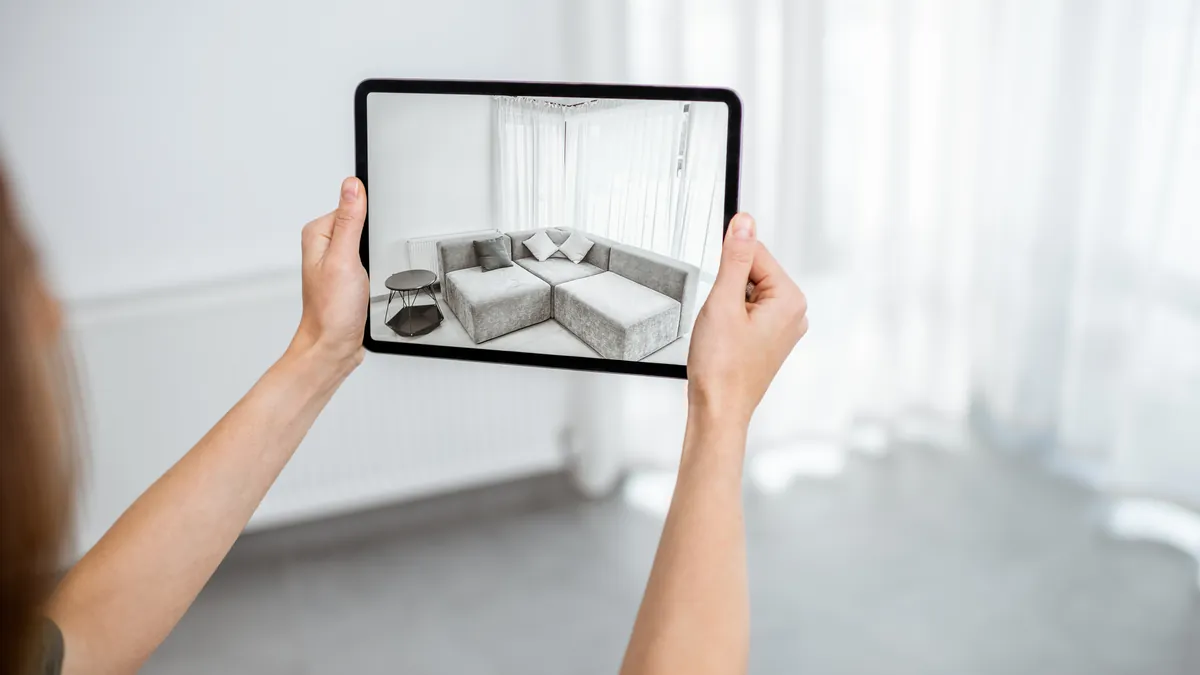
Short answer: the goal is to reduce uncertainty and help your customer imagine they already have the product in their hands.
1. Product Photos and Videos in Use
A photo on a white background informs; a photo of the product in someone's hands, in the kitchen or at the office, invites people to imagine it in their life. Add photos that show texture, real size (with a hand or a familiar object next to it) and finishing details. A short video of someone opening, using or trying the product is the closest thing to touching it.
And so that more photos don't slow down your store, check out the key tools to compress photos online.
2. Zoom and 360° View
Let customers "handle" the product: high-resolution zoom to see seams, materials or textures, and a 360° view to rotate it. On mobile, that finger gesture is exactly the kind of tactile interaction that, according to Brasel and Gips, raises the sense of ownership.
3. Augmented Reality
If you sell furniture, home decor, eyewear, makeup or any product where customers wonder "how will it look in my home or on me?", augmented reality answers that question. If you sell expensive or niche products, it's worth considering.
4. Configurators
Choosing color, size, engraving or combinations lets customers build "their" product. They're no longer looking at just any product, but at the one they put together. Show a preview that changes with each choice.
5. Free Samples and Trials
The closest thing to touching is trying. If your product allows it, offer samples, trial kits, a trial version of your service or a trial period.
6. Easy, Clearly Explained Returns
Someone who can't touch before buying needs to know they can change their mind. In Chile, the law also grants a 10-day right of withdrawal for products bought online, with some exceptions such as perishable or personalized products (Decree 52 of 2024, BCN; SERNAC). Use it to your advantage: explain your exchange and return policy in plain language, close to the buy button and not hidden in the footer.
7. Customer Reviews with Photos
Photos from other buyers show the product in real hands and real homes. Ask for photos in the post-purchase email and feature them on the product page. To make sure that email lands in the inbox and not in spam, read our guide to SPF, DKIM and DMARC.
8. Copy That Invites People to Imagine It's Already Theirs
Since imagining touch increases the sense of ownership, apply it to your descriptions: instead of "100% wool jacket," try "feel the warmth of the wool the moment you put it on, on a cold southern morning." Use words about texture, weight and temperature, and write in the second person.
Where to Start on a Small Budget
Short answer: start with in-use photos, copy and your return policy. They're inexpensive and tackle uncertainty right away.
- Review your 10 best-selling products and ask yourself: can someone imagine how it feels without touching it?
- Rewrite their descriptions with sensory language and in the second person.
- Add at least one in-use photo and one scale photo per product.
- Highlight exchanges and returns next to the buy button.
- Ask for photo reviews after every purchase.
- Measure: compare conversion before and after for those products. With data in hand, you can decide whether to invest in video, 360° or augmented reality.
Frequently Asked Questions
What Is the Endowment Effect?
It's the tendency to value something more simply because it's ours. Kahneman, Knetsch and Thaler demonstrated it in 1990 with experiments buying and selling mugs: those who owned them asked for much more to give them up than others would pay to buy them.
Is It True That Apple Tilts Its Screens So People Touch Them?
That's what's been reported. Carmine Gallo told the story in Forbes in 2012 and other media repeated it, but Apple has never officially confirmed it. Take it as an illustrative example, not a proven fact.
Does Touching a Product Really Increase Sales?
Research shows that touching an object increases the feeling that it's yours and the value you assign to it (Peck and Shu, 2009). The effect depends on the product and the person.
How Can I Replace Touch in My Online Store?
With in-use photos and videos, zoom and 360°, augmented reality, configurators, samples, clear returns, photo reviews and sensory copy, so your customer can imagine they already have it.
Is Augmented Reality Worth the Investment?
It depends on your product. The evidence indicates it pays off more for expensive, niche or lesser-known-brand products, where customers have more doubts (Tan, Chandukala and Reddy, 2022). If you sell inexpensive, well-known products, you're probably better off starting with photos and copy.
Does This Also Work If I Sell Services?
Yes. You can't touch a service, but you can try it: a demo, a free trial or case studies with photos and videos of real customers play the same role.
Want Your Customers to "Touch" Your Product on Your Website?
At Tucango we help your online store sell more: we review your product pages, photos and copy, and propose concrete improvements so your customers buy with confidence.
- Need a new store or want to improve the one you have? Check out our web development and ecommerce service.
- Want product photos and videos that sell? Learn about our audiovisual production.
- Need more traffic and better copy? Let's talk with our digital marketing team.
👉 Contact us and we'll review your online store.
Sources
- How Apple Store Seduces You With The Tilt Of Its Laptops — Carmine Gallo, Forbes, June 14, 2012 — https://www.forbes.com/sites/carminegallo/2012/06/14/why-the-new-macbook-pro-is-tilted-70-degrees-in-an-apple-store/
- The Screen of Each Laptop in the Apple Store Is Set to the Exact Same Angle — The Atlantic, June 2012 — https://www.theatlantic.com/technology/archive/2012/06/the-screen-of-each-laptop-in-the-apple-store-is-set-to-the-exact-same-angle/258592/
- Apple has changed the precise angle at which all laptop screens must be displayed in its stores — Jim Edwards, Business Insider, August 18, 2015 — https://www.businessinsider.com/apple-changes-angle-of-laptop-screen-displayed-in-stores-to-76-degrees-2015-8
- The Apple Experience: Secrets to Building Insanely Great Customer Loyalty — Carmine Gallo, McGraw-Hill, 2012, chapter 17 "Design Multisensory Experiences" — https://www.oreilly.com/library/view/the-apple-experience/9780071793209/e9780071793208_c17.html
- Experimental Tests of the Endowment Effect and the Coase Theorem — Kahneman, Knetsch and Thaler, Journal of Political Economy, 98(6), 1325-1348, 1990 — https://doi.org/10.1086/261737
- The Effect of Mere Touch on Perceived Ownership — Peck and Shu, Journal of Consumer Research, 36(3), 434-447, 2009 — https://doi.org/10.1086/598614
- Individual Differences in Haptic Information Processing: The "Need for Touch" Scale — Peck and Childers, Journal of Consumer Research, 30(3), 430-442, 2003 — https://doi.org/10.1086/378619
- To Have and to Hold: The Influence of Haptic Information on Product Judgments — Peck and Childers, Journal of Marketing, 67(2), 35-48, 2003 — https://doi.org/10.1509/jmkg.67.2.35.18612
- In search of a surrogate for touch: The effect of haptic imagery on perceived ownership — Peck, Barger and Webb, Journal of Consumer Psychology, 23(2), 189-196, 2013 — https://doi.org/10.1016/j.jcps.2012.09.001
- Tablets, touchscreens, and touchpads: How varying touch interfaces trigger psychological ownership and endowment — Brasel and Gips, Journal of Consumer Psychology, 24(2), 226-233, 2014 — https://doi.org/10.1016/j.jcps.2013.10.003
- Augmented Reality in Retail and Its Impact on Sales — Tan, Chandukala and Reddy, Journal of Marketing, 86(1), 48-66, 2022 — https://doi.org/10.1177/0022242921995449
- Decree 52 (2024), regulation of the right of withdrawal, Law 19,496 (in Spanish) — Library of the National Congress of Chile (BCN) — https://www.bcn.cl/leychile/Navegar?idNorma=1206144
- Article 3 bis, Law 19,496 (right of withdrawal) (in Spanish) — SERNAC — https://www.sernac.cl/portal/609/w3-article-52791.html